Community matters to us because Wordscapes has never been just a puzzle game.
At its best, it is a place where people connect, compete, help each other, make friends, and sometimes even bring families together. That idea sits right at the center of how we think about the game and how we support it behind the scenes.
At WordscapesCon, our community team shared how that relationship has grown over time, how player feedback moves through the studio, and why the Ambassador program has become such an important part of the process. What follows is a full look at that story.
Table of Contents
- Why community became such a big focus
- The community was building things before we ever asked
- Why Reddit matters, even when we stay quiet there
- What community means to us in practice
- What the Wordscapes community looks like now
- What the community team is actually trying to do
- How the community influences the whole company
- How player feedback gets handled behind the scenes
- The bug lifecycle: from player report to potential fix
- How bugs are prioritized
- Why not fix everything at once?
- The biggest challenges the team faces
- Why the Ambassador program exists
- How ambassadors help in real situations
- Has the Ambassador program worked?
- Where the program goes from here
- Which platforms matter most right now
- FAQ
- The bigger takeaway
Why community became such a big focus
To understand where we are now, it helps to go back a few years.
In January 2020, Wordscapes had been around for roughly three years. At that point, the game was much simpler than it is today. We had levels, but not unlimited levels yet. New levels were still being released every few weeks or months. There was a daily puzzle, an individual tournament, and the piggy bank. Team tournaments were not in the game yet, and many of the features players now think of as core parts of the experience simply did not exist.
Our Facebook presence existed, but it was fairly quiet. Posts might go up once a month, sometimes less, usually to say that new levels were available.
Then two things started happening at the same time. We began investing more intentionally in growing the community, and the game itself started expanding. Crowns, for example, were introduced in February 2020. That gave us more opportunities to talk with players, share updates, and build momentum around what Wordscapes could become.
Very quickly, one thing became obvious: this community was already incredibly creative and deeply invested.
Even back when there was less to do in the game, players were posting comments about finishing levels so fast they were worried they would run out of puzzles. People joked about being addicted to Wordscapes and needing a support group. That enthusiasm was real from the start.
The community was building things before we ever asked
As more features rolled out, the community did what great communities do. It didn’t just react. It created.
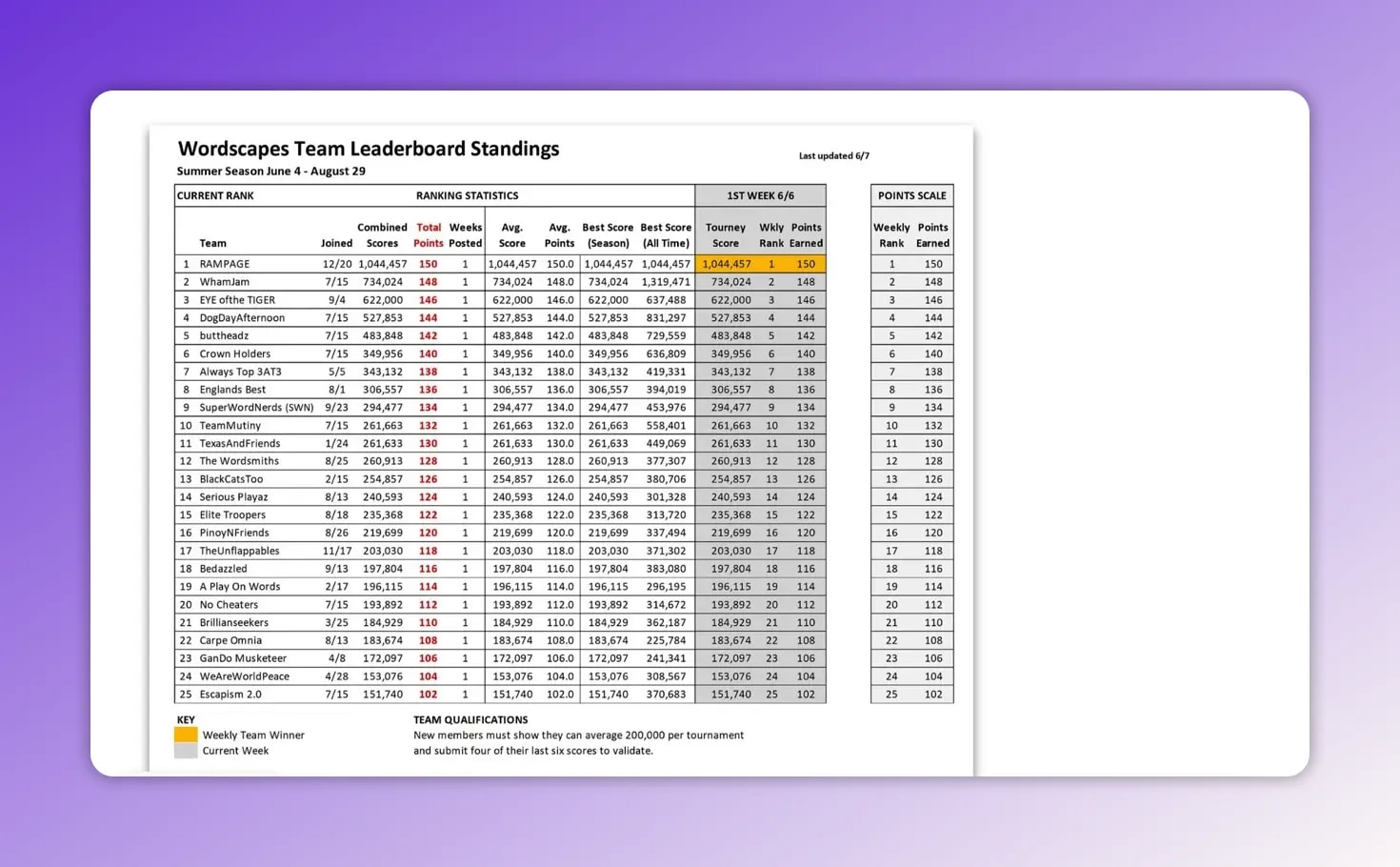
Player-run leaderboards
One of the earliest and most impressive examples was a player-created team leaderboard. Players compiled weekly stats for teams, including:
total points scored
average score
score per minute
team rankings
And they were doing all of this on their own.
What started as an early community effort is still being done every week. That level of organization says a lot about how much players care.
Creative team recruiting
Recruitment posts became another early sign of the culture forming around the game. Teams were not just looking for members. They were marketing themselves with personality.
Some of those first team recruitment posts were memorable because they showed players turning a game mechanic into a social identity. A team wasn’t just a roster. It was a community within the community.
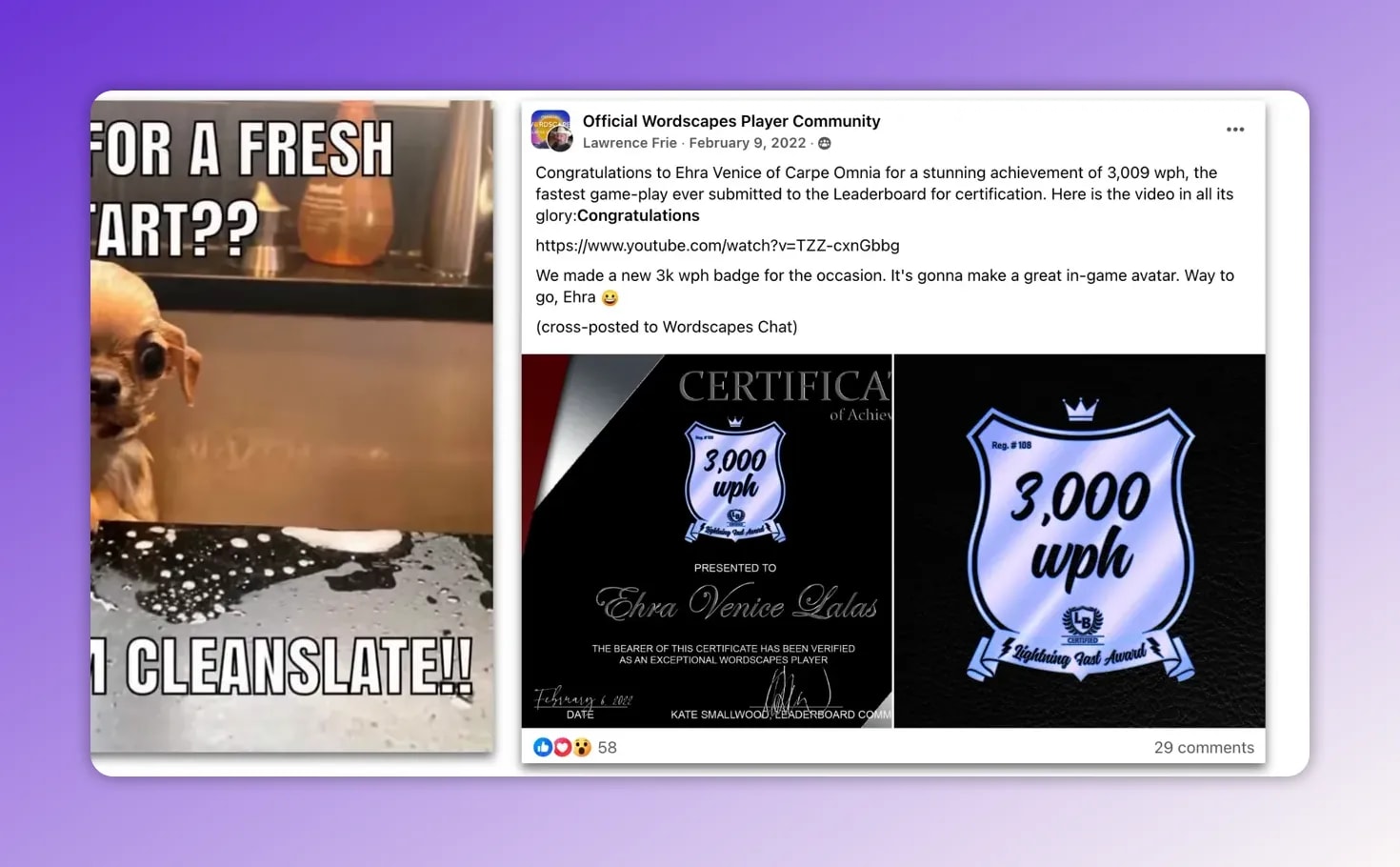
Words-per-hour certifications
Then there were the truly fascinating examples, like players certifying each other’s words per hour.
A player would record themselves playing, others would review the footage to verify that everything looked legitimate, and then they would issue a certificate. One standout example highlighted a young Filipino player named Era reaching 3,000 words per hour.
That is a community inventing its own standards, its own recognition systems, and its own ways to celebrate excellence.
Why Reddit matters, even when we stay quiet there
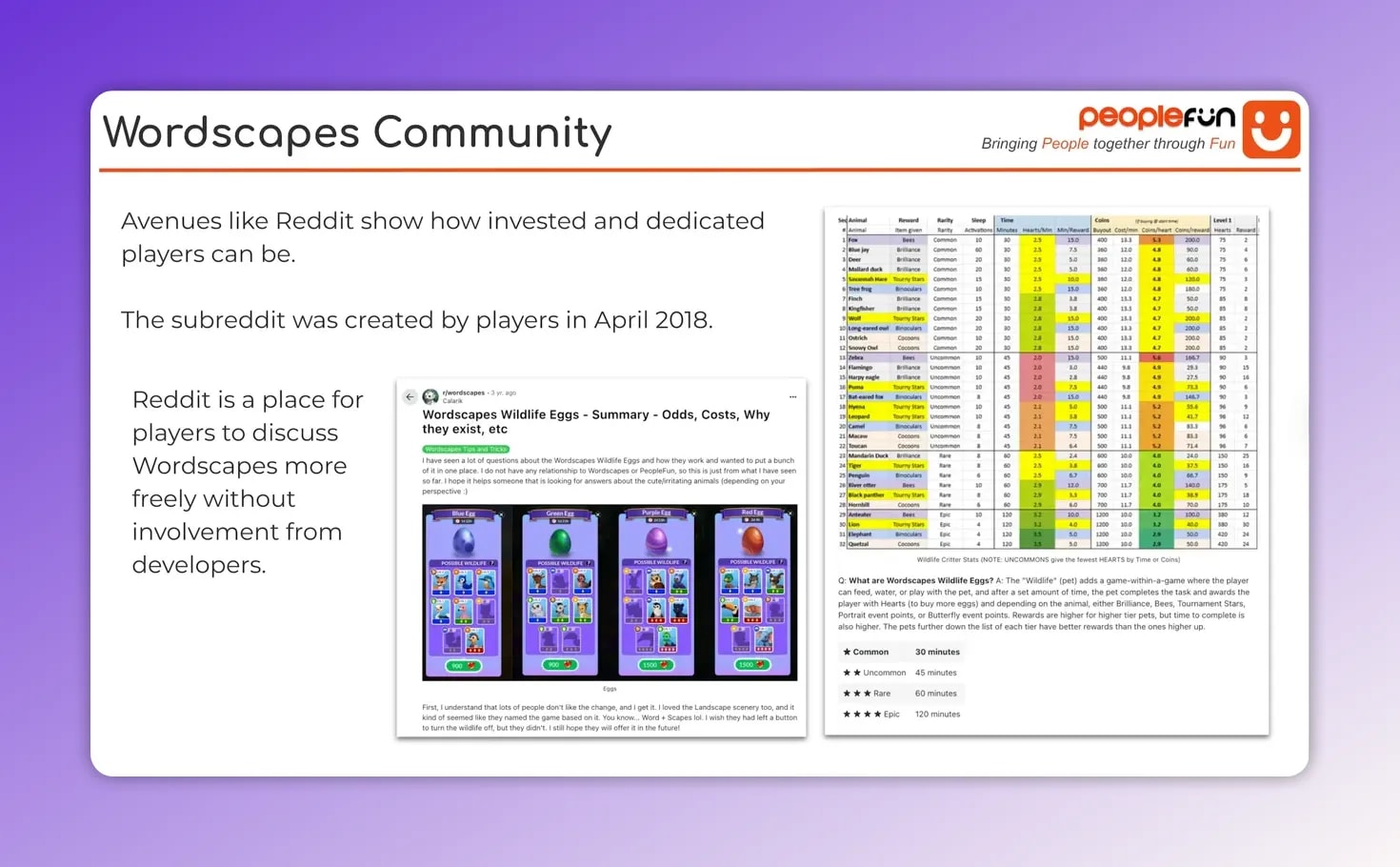
The Wordscapes subreddit is another great example of player ownership.
It was created by players in April 2018, not by us. We have intentionally kept it as a player-first space. We read what is happening there, but we do not actively comment or respond. That is important because players need places where they can talk openly without feeling like the developers are standing in the middle of the conversation.
That does not mean the subreddit goes unnoticed. Quite the opposite.
We read it carefully to understand what players are experiencing, what concerns are surfacing, and how people are interacting with the game in ways we might not have predicted.
A great example came when Wordscapes Wildlife launched. Players quickly created a detailed breakdown of how the feature worked, including:
which animals were included
what rewards they gave
how long rewards took
cost-per-minute calculations
It was such a deep analysis that our QA lead at the time found it genuinely useful while building a test plan for the feature. That is one of the clearest examples of the community actively helping improve the game.
What community means to us in practice
We saw how much the community was investing in Wordscapes, and that made one thing very clear: we needed to invest back.
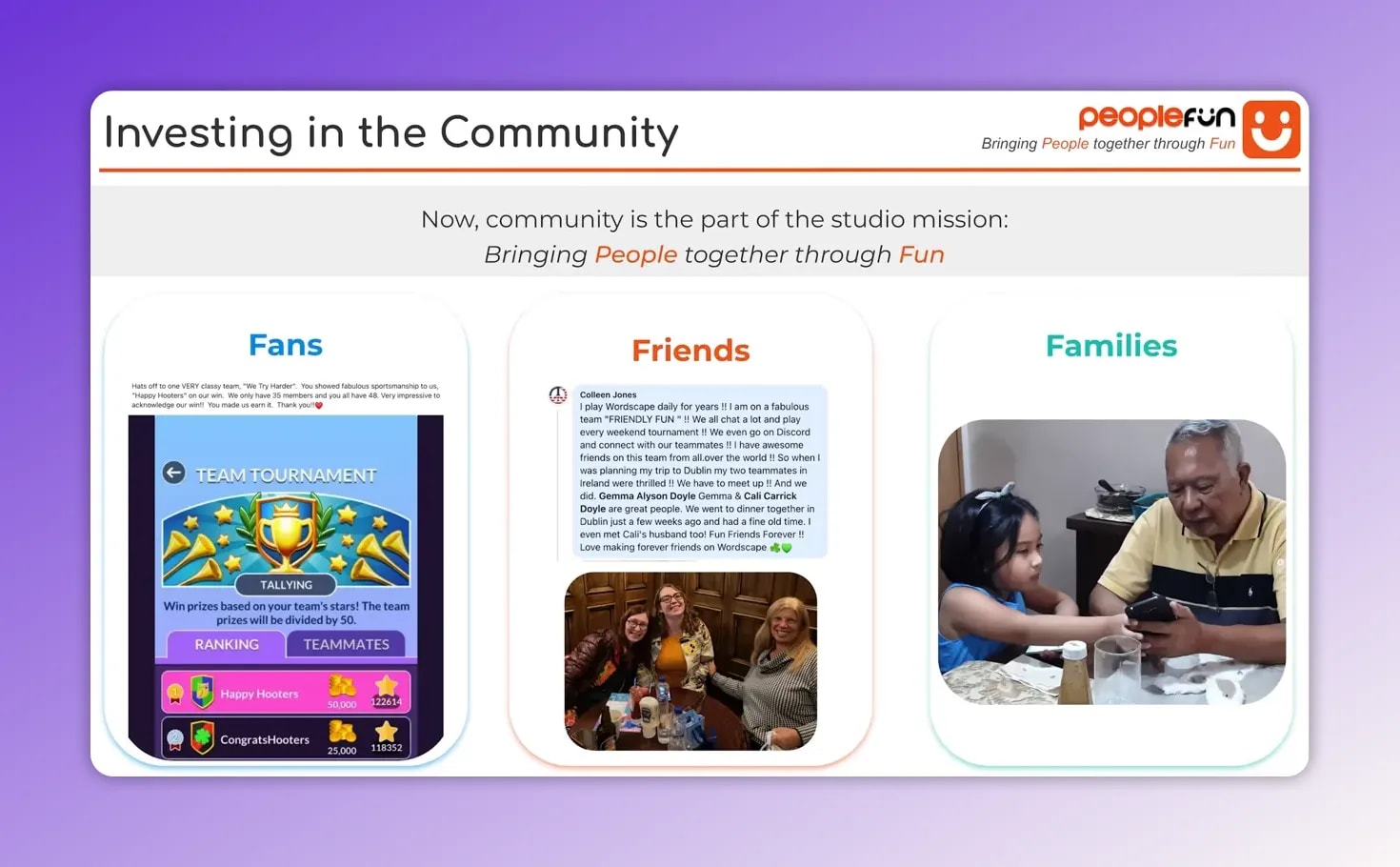
That aligns directly with our studio mission of bringing people together through fun. And when we say that, we mean it broadly. Fans, friends, and families all matter here.
Fans
Players often find clever ways to connect with each other, even when the game doesn’t provide a direct tool to do it.
One example we love involved a team called Happy Hooters winning a tournament. The second-place team wanted to congratulate them, but there was no direct way to message another team. So they changed their own team name to “Congrats Hooters.”
The winning team saw it, appreciated it, and that small moment created a real sense of shared community.
Friends
Wordscapes has also helped form real friendships outside the game.
We shared a photo of players who originally met on the same team and later became real-life friends, eventually meeting up in Dublin. That is the kind of outcome that reminds us this work matters.
Families
And sometimes the impact shows up across generations.
Seeing family members of different ages come together around something we created means a lot to us. A word game can be surprisingly powerful when it becomes shared ground between parents, kids, grandparents, and everyone in between.
What the Wordscapes community looks like now
That investment has led to real growth.
Today, the Wordscapes community includes:
about 394,000 Facebook followers
a Facebook group with roughly 22,000 members
around 100,000 Instagram followers
about 10,000 subreddit members
We also have much more to talk about now because the game itself has grown so much. There are events every day of the week, and every Sunday we post a weekly events calendar. Our official Wordscapes player community on Facebook gives players a place to have deeper conversations, recruit for teams, and report issues while staying connected with each other.
Wordscapes means a lot to our players, and our players mean a lot to us.
What the community team is actually trying to do
Our role is not just to post updates on social media. The goal is much bigger than that.
As a community team, we want to:
build a communication bridge between players and the development team
make sure players feel heard
improve overall community satisfaction
foster belonging and connection across Facebook, Instagram, and beyond
support open communication through social media and customer support
Why is that so important?
Because a strong community makes the game more meaningful, more personal, and more fun. It builds trust. It helps players feel seen, valued, and connected. And it gives the studio valuable insight into how people are actually experiencing the game.
How the community influences the whole company
This isn’t something that sits off to the side of development. It is part of how the company works every week.
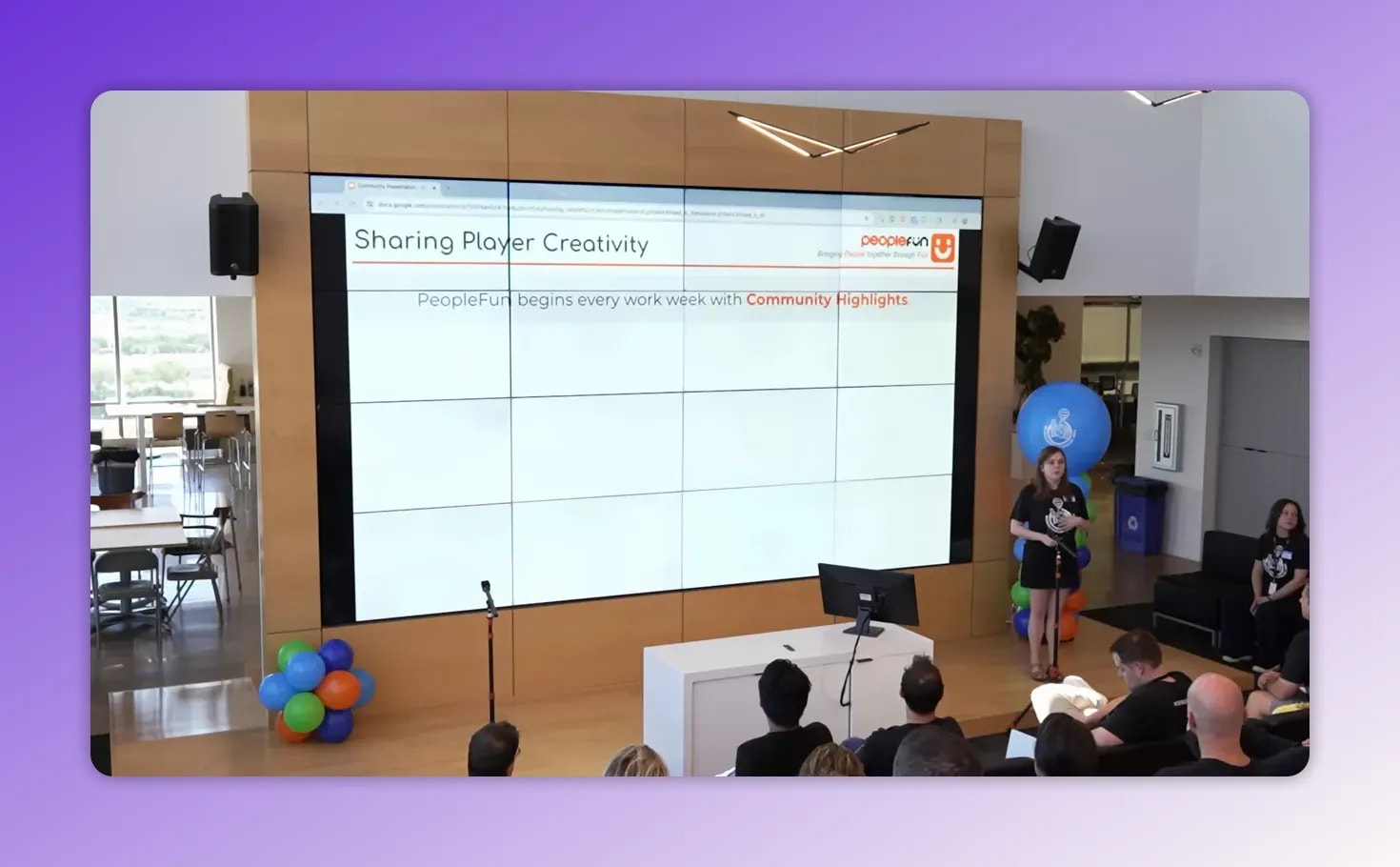
Every Monday morning, the entire company starts with a meeting to talk about what teams have been working on and what is coming up. That meeting ends with community highlights.
Those highlights can include:
popular subreddit posts
memes and player-created images
creative community conversations
responses from contests and prompts
One example was a post about the “14 stages” of working with Wordscapes animals, which captured a player’s emotional journey with that feature. It was funny, relatable, and useful. Sharing things like that helps everyone across the company start the week with the right perspective, both emotionally and practically.
It puts players at the center of the work.
How player feedback gets handled behind the scenes
One of the most important parts of the session was a transparent look at how feedback and bug reports actually move through the team.
At PeopleFun, trust is one of the company’s core values. And with community, trust starts by listening.
That includes:
feedback on the game experience
feature requests
bug reports and technical issues
The process is simple in principle, even if it is complex in practice: listen, prioritize, act.
Where feedback comes from
Every day, we monitor feedback across multiple sources. That includes Instagram, Facebook, and Reddit, along with customer support channels.
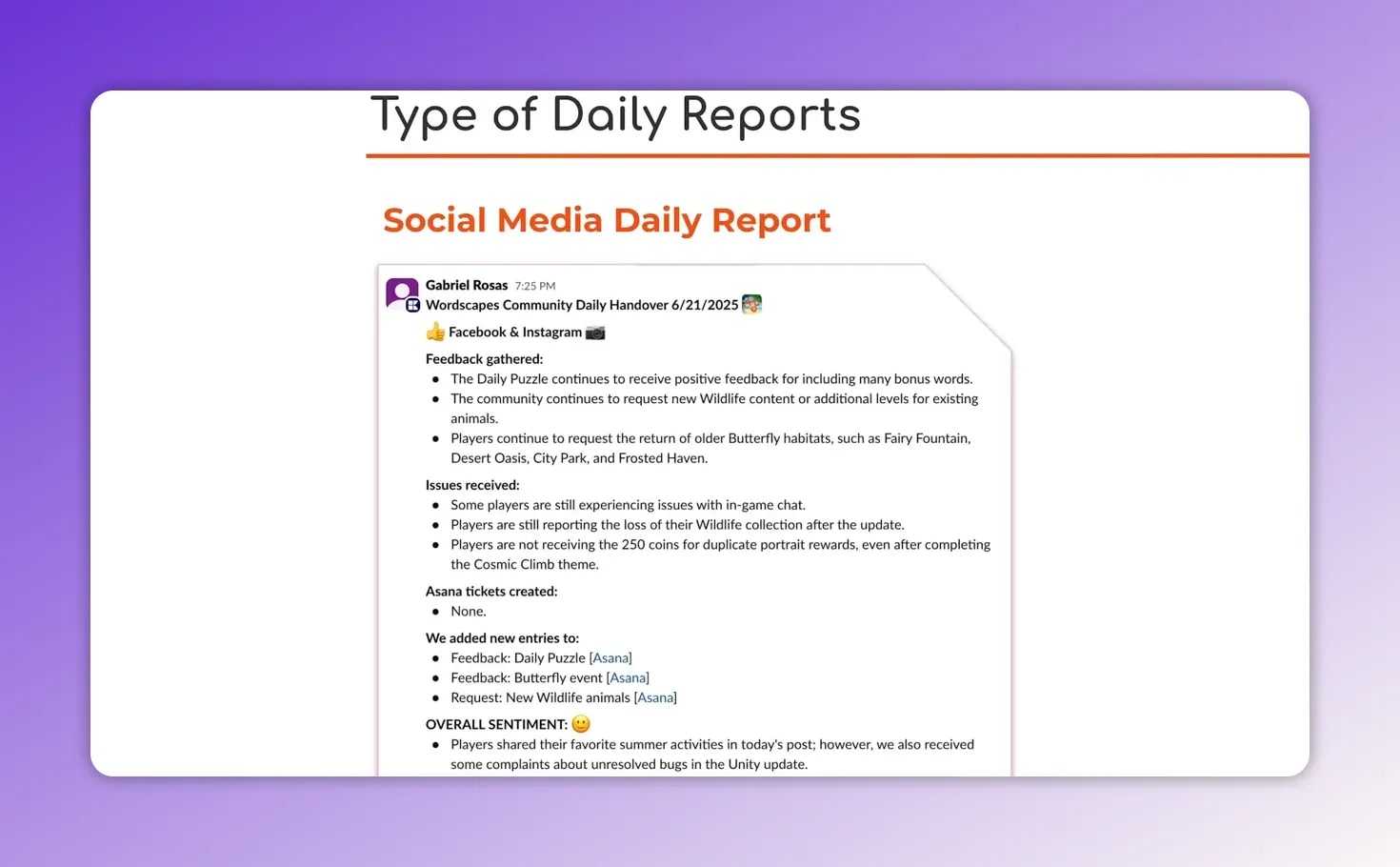
Two daily reports are especially important:
1. Social media reporting
Moderators read comments across our posts and gather issues, feedback, and concerns. Those findings are documented in Asana and then shared with the Wordscapes team.
2. Customer support reporting
We also track support tickets daily. We look at how many tickets came in, whether the contact rate is rising, and what issues are driving that increase.
Every morning, those issues are reviewed so we can decide what needs attention and when.
The bug lifecycle: from player report to potential fix
When players ask what happens after they report a problem, here is the real answer.
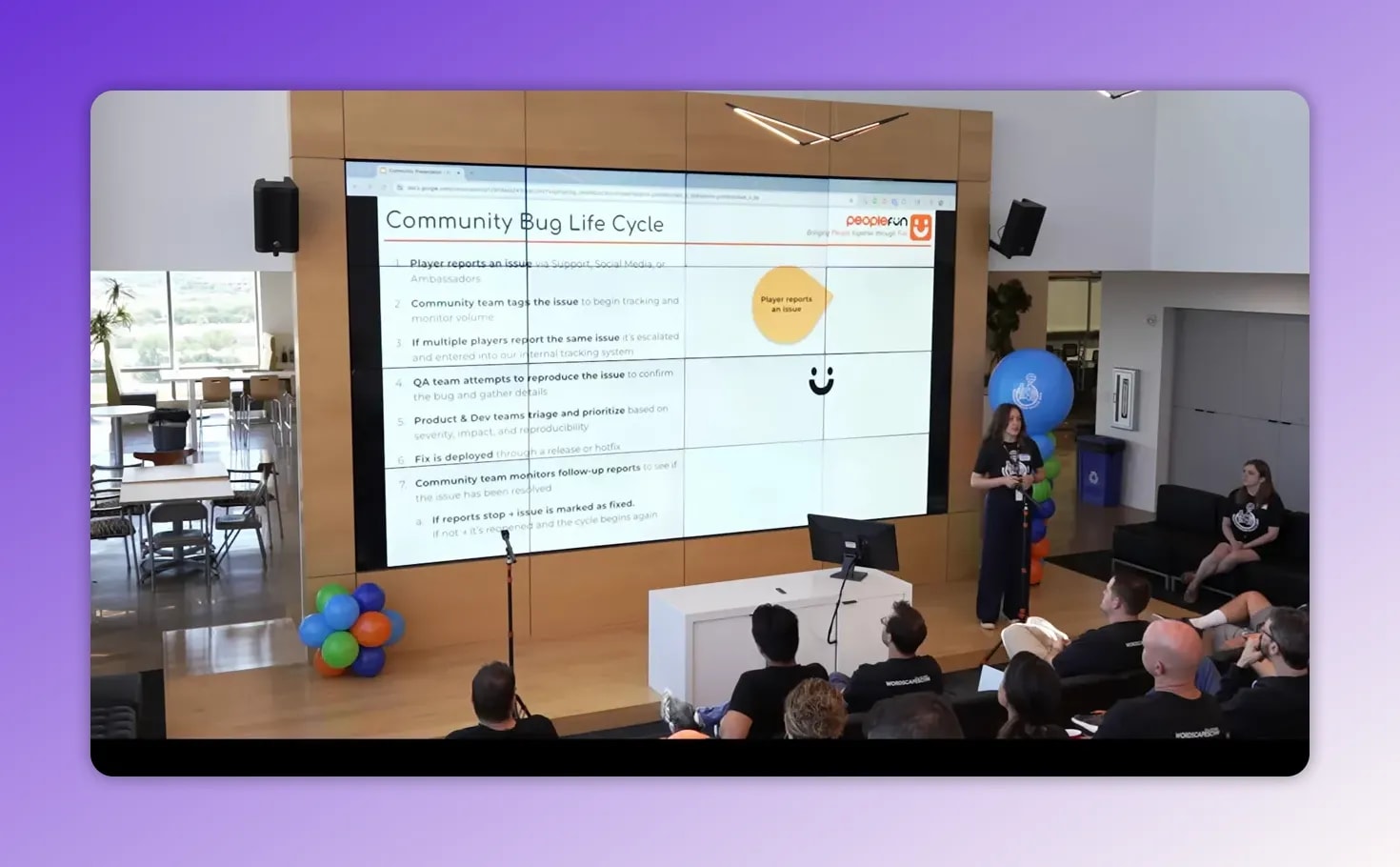
A player reports an issue. This may happen through social media, support, or another channel.
The community team starts tracking it. We create tags and start looking for patterns.
We gather supporting details. Are other players reporting the same thing? Do we know what broke? Can we identify steps to reproduce it? Do we have screenshots?
The issue is shared with the Wordscapes team. Once enough information is collected, ownership shifts to the game team.
QA tries to reproduce the bug. If they can reproduce it on their own devices, that is a strong step toward fixing it quickly.
The product team triages it. They decide when the issue should be fixed based on its impact and severity.
The fix is released. After deployment, the issue returns to the community side because we need to confirm whether it was actually resolved for players.
If the bug remains, the cycle starts again.
That last part matters. A fix is only successful if the player experience is actually improved.
How bugs are prioritized
Not every issue can be fixed at once, and not every issue should be fixed in the same order.
When prioritizing bugs, the team looks at several factors:
Player impact: how many people are affected?
Severity: does the issue break core functionality or cause players to lose progress?
Recency: was the issue introduced in a recent release or feature?
Support tools: if a player reaches out, can customer support help in the meantime?
Reproducibility: can the team recreate the issue internally?
That means volume alone does not determine priority.
If 1,000 players report a visual glitch, but 100 players are completely blocked from opening the game, the game-breaking issue will take priority. Severity matters.
Why not fix everything at once?
This is one of the most understandable player questions.
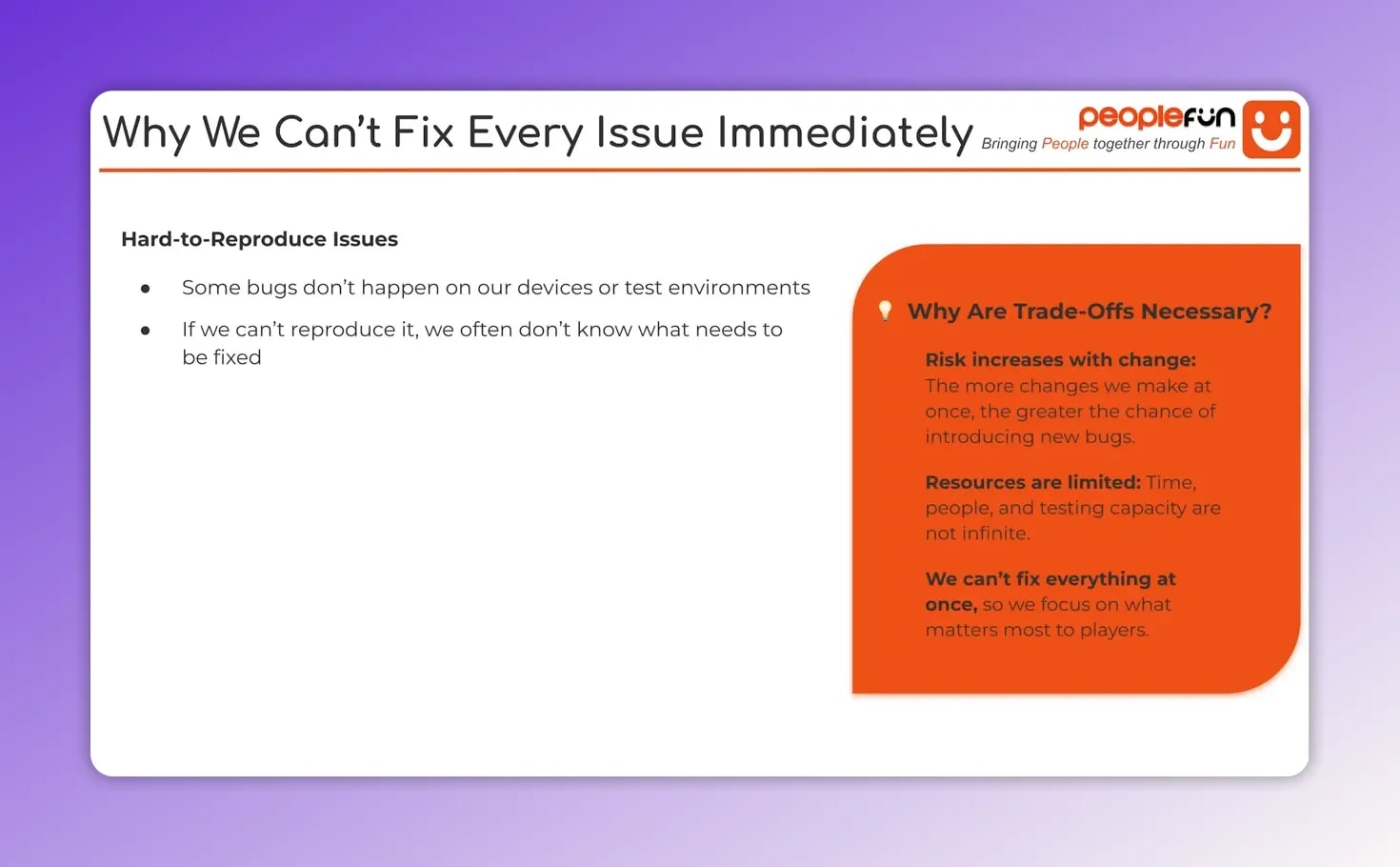
The short answer is that making too many changes at once increases the risk of breaking something else. That is a common development best practice across the industry. Smaller batches of fixes and features are safer, easier to test, and easier to release with confidence.
At Wordscapes, releases happen on a cadence of about every three weeks.
There is also a timing issue. Imagine 10 percent of players cannot open the game at all, while other players are dealing with visual glitches. If the team waits to bundle everything together, the players who are fully blocked may have to wait much longer for relief. So the most severe issues often need to move first.
That can mean some players receive an update where their own issue has not been addressed yet, even though important fixes were included for others.
It is not ideal, but it is often the right call.
The biggest challenges the team faces
Even with a strong process, there are two major challenges that can slow things down.
1. Hard-to-reproduce issues
Some bugs affect only a small portion of players and simply do not appear on internal devices, no matter how many scenarios QA tests.
When that happens, fixing the bug becomes much more difficult. QA needs to be able to get into the broken state to confirm a fix actually works. If the team cannot reproduce the issue, there may be multiple attempts to fix it before the right solution is found.
2. Limited information
Sometimes a player reports something like, “I can’t play the tournament,” but that could mean many different things.
Is the tournament icon missing?
Are stars not being counted?
Is the game failing to launch?
If the player does not respond to follow-up questions or share screenshots, it takes longer to understand what is actually broken and how to route that issue properly.
This is exactly where ambassadors have become so valuable.
Why the Ambassador program exists
The Ambassador program was created to strengthen that connection with players and improve the speed and quality of information coming back to the team.
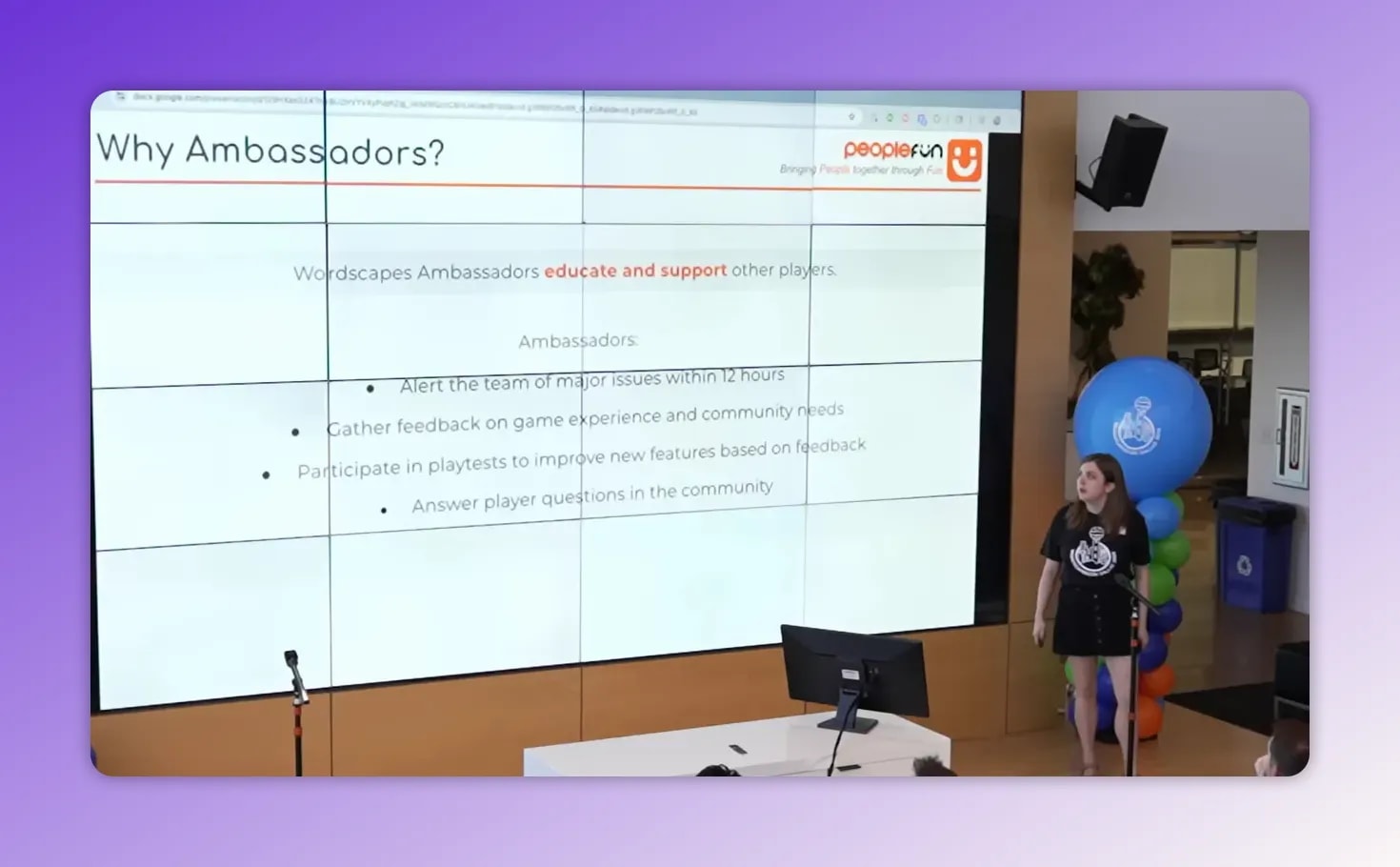
The core goal is simple: educate and support other players.
Our Wordscapes ambassadors help by:
alerting the development team to major issues, often within 12 hours
gathering feedback on game experience and community needs
participating in playtests for unreleased features or builds
answering player questions in the community
building trust through more personal player-to-player communication
That last point is huge.
We cannot realistically speak one-on-one with every player online. Ambassadors can help bridge that gap, because they are players too. They can explain what is happening in a way that feels more direct, more human, and more trusted.
How ambassadors help in real situations
The value of the program becomes especially clear when something goes wrong.
Confirming whether a fix worked
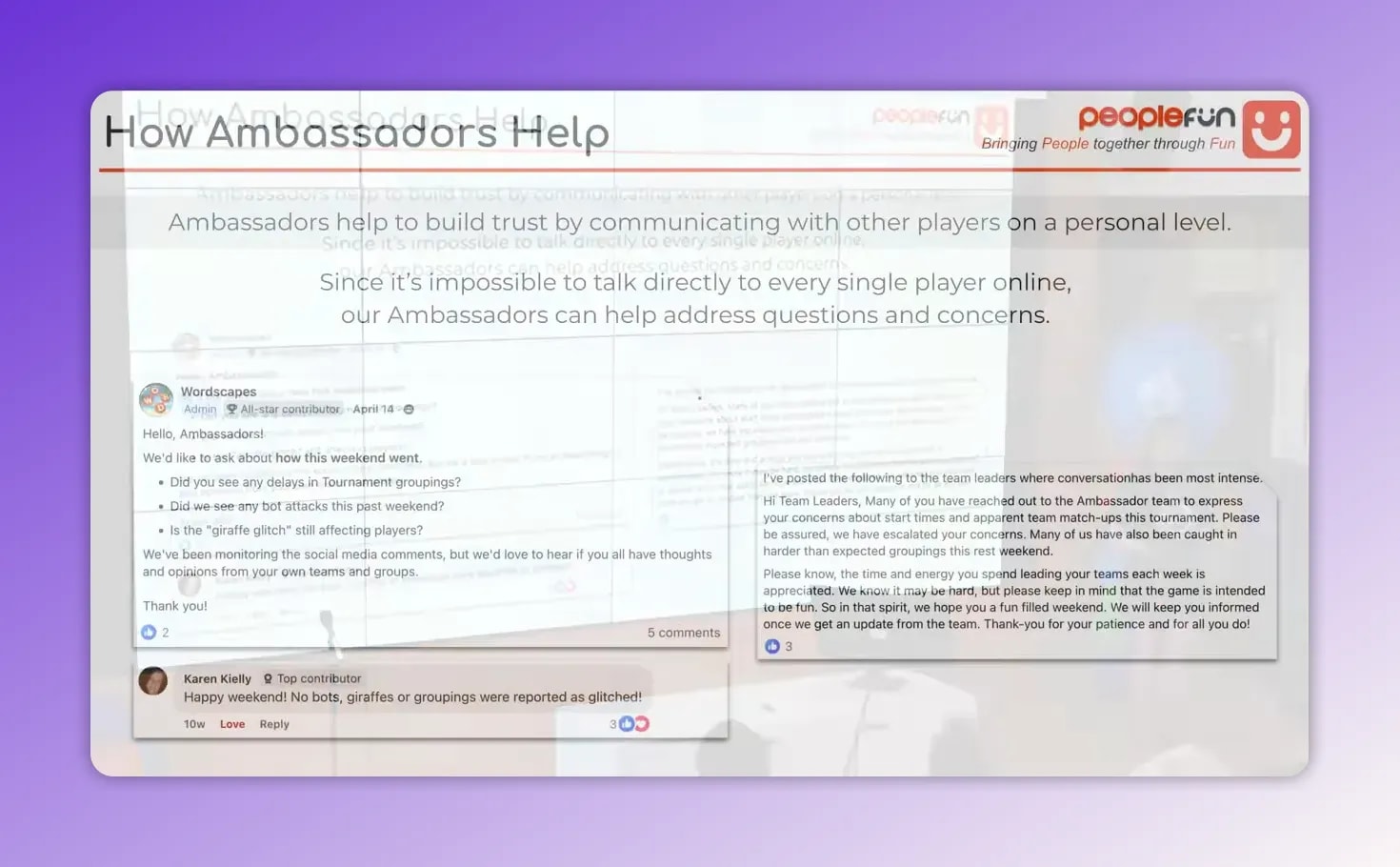
At one point, there was an issue with tournament groupings not working correctly. After attempting a fix, we could see positive signs in community comments, but we wanted stronger confirmation.
So we asked ambassadors targeted questions:
Did you notice any delays this weekend?
Did you see any bot attacks?
Is the glitch still affecting players?
An ambassador named Karen responded that everything looked good. That kind of direct, grounded confirmation is incredibly helpful.
Building trust during frustrating issues
When tournament problems were causing understandable frustration, players wanted to know whether the issue was really being worked on.
Because ambassadors have a more direct line to the team, they can share accurate updates with community leaders and team captains. Those leaders can then pass information on to their own teams. That dramatically improves communication reach and helps restore confidence during a rough moment.
Reporting bugs with useful detail
Ambassadors also tend to report bugs in a way that makes them easier to act on.
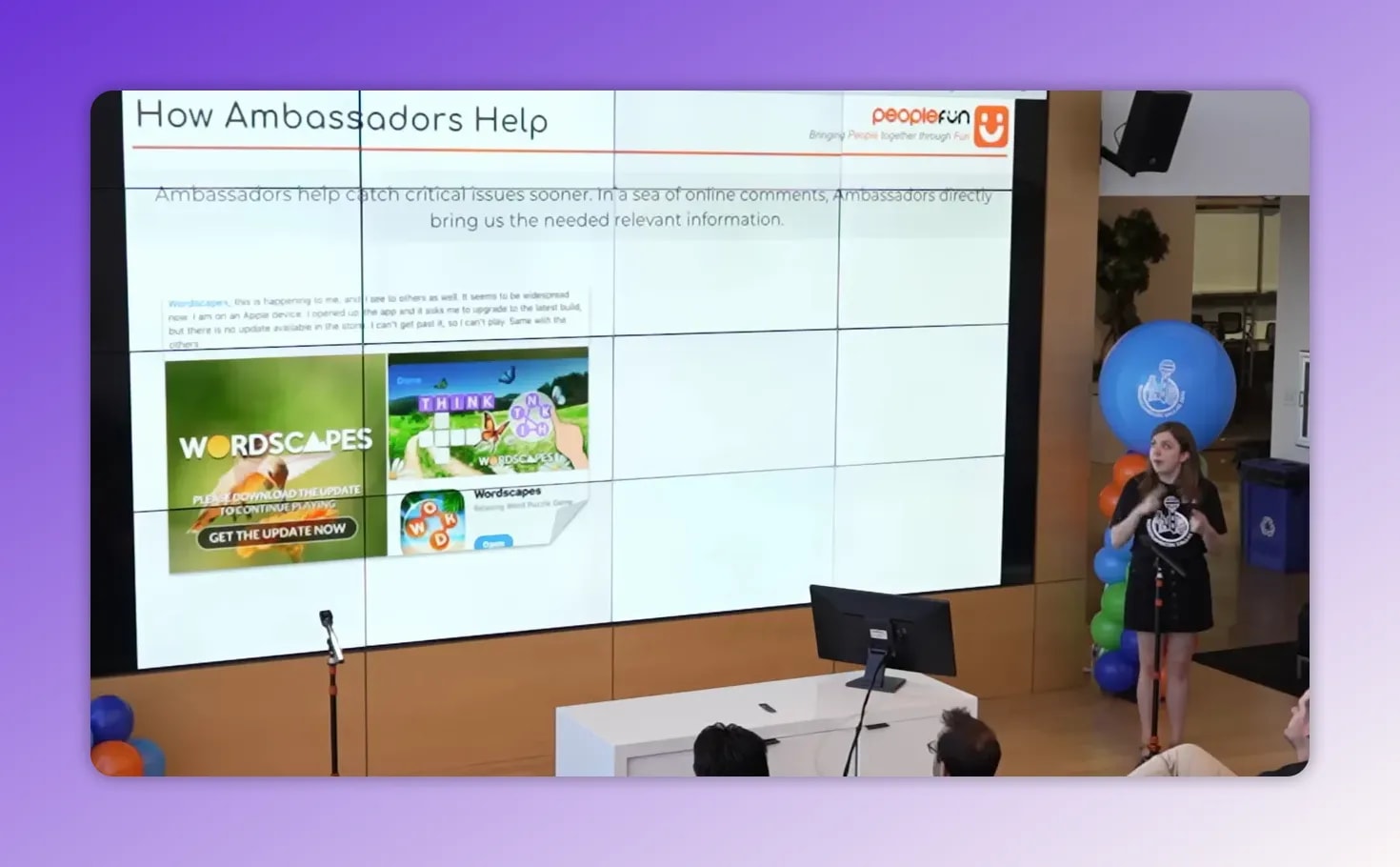
For example, during one issue where the game would not open, an ambassador explained that:
the problem was happening to them and others
it appeared widespread
they were using an Apple device
the issue happened after a specific prompt
they could not get past it or play at all
That is exactly the kind of report that helps a team assess severity and move fast.
In another example, an ambassador identified the issue as occurring on version 3.2.9 and pointed out that affected players could not contact support because the app had become completely unresponsive. That mattered because it explained why support ticket volume might not reflect the scale of the problem.
Testing unreleased builds
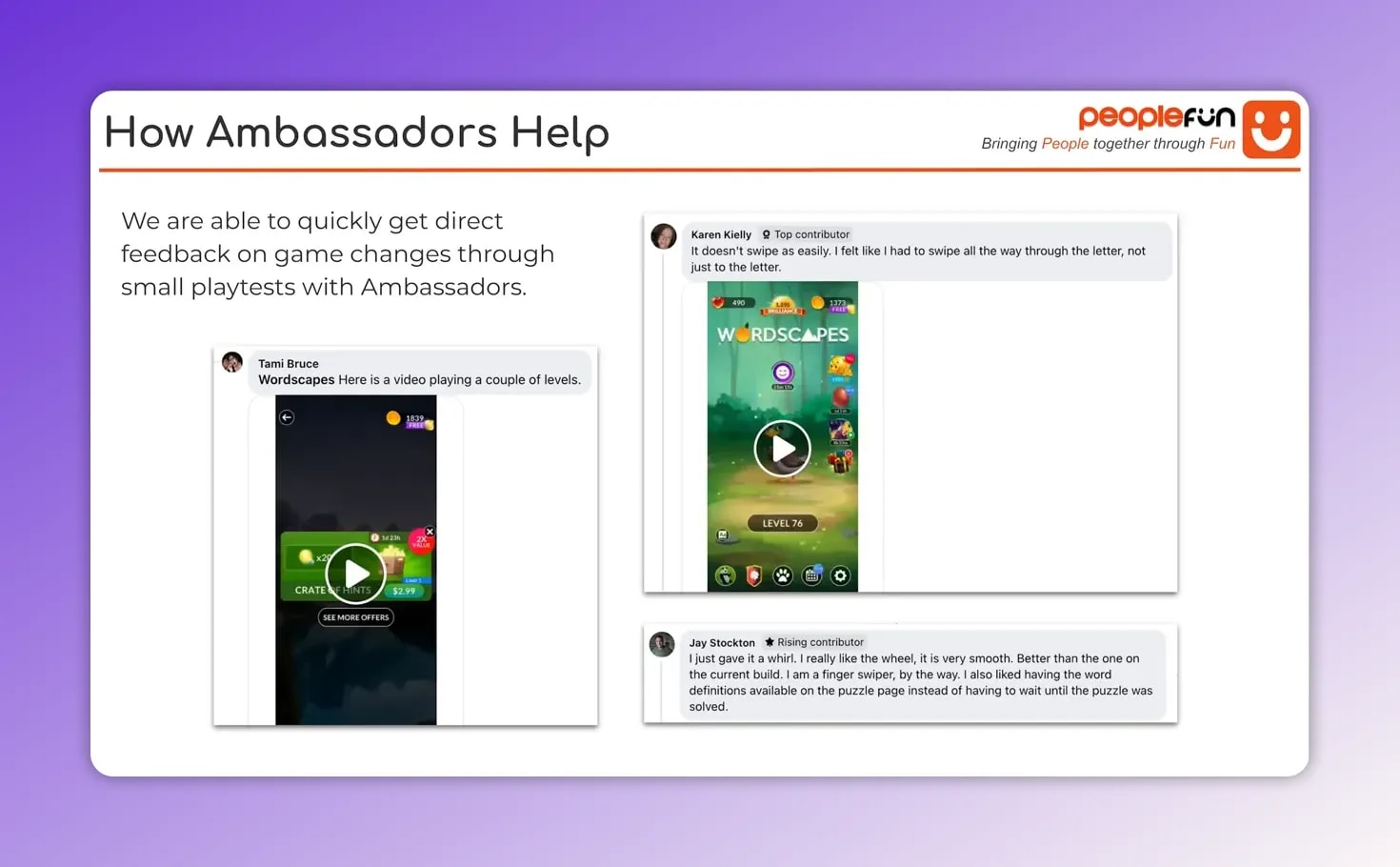
Ambassadors are also sometimes invited to provide feedback before changes go live.
In one case, they received an unreleased build, tested changes, and sent back screen recordings along with detailed notes. That helped the team understand what felt right, what did not, and what should be improved before release.
It is a smart way to catch issues early and make features better before they reach the wider player base.
Has the Ambassador program worked?
Yes, absolutely.
This is the first year of the program, so naturally there is still a lot being learned about how to support ambassadors well and how they can best support the team in return. But even at this early stage, it has been a major success.
It has strengthened player connections, improved feedback loops, and created faster pathways for surfacing important issues.
And with WordscapesCon bringing people together in person, it has also opened the door to even more ideas about how this relationship can grow.
Where the program goes from here
The plan is for the current ambassadors to serve for the year. The following year, another group of ten ambassadors will be selected.
Those current ambassadors cannot reapply immediately the next year, but they can return the year after that. The idea is to create some rotation, give people a break, and make room for new voices.
For now, the program will probably stay around ten ambassadors rather than growing dramatically in size. The bigger opportunity is not necessarily in adding more people, but in doing more together.
That includes improving the experience for future ambassadors by collecting feedback from the current group and learning what support would help them most.
Which platforms matter most right now
Players often ask whether Wordscapes should expand more aggressively onto platforms like TikTok, Twitch, or YouTube.
Those platforms are definitely on the radar, and we know Wordscapes players are active there. But right now, the priority is to stay grounded where the community is already strongest.
That means continuing to focus on:
the Facebook page
the Facebook group
Instagram
Reddit
Facebook in particular remains the biggest center of activity.
FAQ
Does having hundreds of players report the same issue make it more likely to be addressed?
Sometimes, but not automatically. Volume is one factor because it helps show player impact, but severity matters just as much, and often more. A game-breaking bug affecting fewer players may be prioritized over a widely reported visual glitch.
Can players report too many issues?
No. It is never “too many” in the sense that reports are unwelcome. Reporting helps the team understand what is happening. The more useful part is making those reports clear and specific so the team can identify the issue faster.
What makes a bug report more useful?
The best reports include details like the device type, app version, what happened right before the issue occurred, whether the problem is repeatable, and screenshots or screen recordings when possible. Specific information shortens the time it takes to investigate.
Why do some fixes take longer than players expect?
There are a few common reasons. Some bugs are hard to reproduce internally. Some reports do not include enough information at first. And sometimes the team has to prioritize more severe issues first so that players who are fully blocked can get help sooner.
Why are fixes released in batches instead of all at once?
Making too many code changes at once increases the risk of introducing new problems. Smaller batches are safer to test, safer to deploy, and better for overall stability. Wordscapes generally releases updates on a cadence of about every three weeks.
What should players do when the team already knows about an issue?
Once the team clearly understands an issue and is actively working on a fix, there may not be much new information to share right away. In those cases, automated responses can help acknowledge the report while the team works. Players may not love bots, but the goal is to signal that the issue is known and in progress.
Will the Ambassador program continue to grow?
Yes, though growth may be more about expanding what ambassadors can do rather than significantly increasing the number of participants. For now, the plan is to keep the group around ten people each year while continuing to improve the program and bring in new voices over time.
The bigger takeaway
What stood out most from this session was not just that Wordscapes has a large community. It is that the community actively shapes the game.
Players create resources, organize each other, surface issues, test ideas, spread information, and help us understand the real experience of playing Wordscapes every day. The Ambassador program is one way of formalizing that connection, but the spirit behind it has been there all along.
Strong communities do more than make games feel lively. They make games feel meaningful.
That is why we care so much about listening well, responding clearly, and continuing to build something that brings people together through fun.
This article was created from the video Wordscapes – Community | Ambassadors | Feedback | WordscapesCon with the help of AI.
Good morning, everyone. And, Emily and I, we are thrilled to welcome you at our first WordscapesCon. I want to talk about why community matters so much to us. And to do that, I do want to go back a little bit in Wordscapes history. So back in January of 2020, we had about 165,000 Facebook followers. Now the game had been around for about three years at that point, but there wasn’t too much going on with it. There weren’t too many features. We had the levels, but we didn’t have unlimited levels yet. We were still releasing levels every few weeks, every few months. The daily puzzle. We had the individual tournament, but not the team tournament. The piggy bank was there. That’s all we had going on. January 2020 was also when I first started working here. So before I started working here, there was a Facebook presence, but they would post about once a month, maybe less and once a month because there wasn’t too much to talk about. When they did post, it would usually be saying there are new levels, come play new levels. I started and we really started looking at growing the community. About that same time, new features started coming out, so Crowns were actually first introduced in February of 2020. So I got to start posting about new things like Crown Tournaments and starting to pick up more traction in the community. Really early on, we started seeing comments that showed us just how creative and how enthusiastic this community really is. So even though there wasn’t much going on, We would get comments like I won the last year in a minute. Now I think I won’t win because I’m running out of puzzles. That’s how much they played. A lot of posts about being addicted to Wordscapes. Has anyone ever played Wordscapes? If we’re looking for a support group for this game? And as we started getting more features out, we started getting even more creative and dedicated posts from the community. So our ambassadors will recognize these very well. This first one is an example of the worst games team leader board that is actually put together by players. Now this is one of the very first ones. I scrolled back and I found it, but this is still put together every week. With stats from all of the teams of their points they score their average score, their score per minute, and they rank their teams on their own. We also have a lot of Wordscapes recruitment posts for trying to get people into their team. This is, again, one of the very first ones that we saw from Team Clean Slate. And just so creative seeing how people are trying to recruit players. And I find this one very fascinating. This is an example of how players will certify each other and their words per hour. So a player will film themselves playing and then other players will watch it and make sure everything looks legitimate and then provide a certificate. This one is from our young Filipino player era, who got up to 3000 words per hour. We also have seen a lot of dedication and investment on Reddit. So our subreddit was actually created by players, not by us. And it was created in April of 2018, and we really have kept it as a place for the players. We don’t comment there. We don’t respond because we think it’s important for Escape’s players to have that place to talk more freely without that involvement from the developers. But of course we are reading and we are seeing what their issues are with their concerns. And seeing stuff like this, like when our Wordscapes Wildlife feature first came out, this was created pretty quickly, a summary of what the feature is, but then also really in-depth knowledge about how the feature works and listing out all the animals, all the rewards they give, the minutes per reward, the cost per minute So you can get really deep into this feature, deeper than we probably even imagined that players would. And so much so that our lead of QA at the time for Wordscapes saw this post, was very impressed and thought that actually it was very helpful in creating a test plan for testing this feature ourselves, so the community has helped us in that way as well. So now as mentioned, community is so important to us. We saw how much the community is investing in us. So we want to invest back into the community. It’s our studio mission, bringing people together through fun. And we really want to do that through fans and friends and families. So I have a few examples of this over on fans. We think our players, again, so dedicated big fans of the game, they find creative ways to interact with each other. This is an example of a team happy hunters who won the tournament, and the second place team just really wanted to congratulate them. But there’s no way to actually reach out to other teams so they changed their team name to congrats, Hooters. And they saw it. And we’re very happy and felt that sense of community For our friends example These are friends who actually did meet in the game on a team, and they are friends in real life now. And this is a photo of them meeting up in Dublin And our families example doesn’t have a comment, but I think it really speaks for itself to see different generations coming together over something we created just really means so much to us. So after we’ve invested in the community, here’s a look at what our community looks like. Now. We’re at about 394,000 followers on our Facebook page. We also have a Facebook group, which was started as this initiative to grow the community. About 22,000 members there, 100,000 Instagram followers and 10,000 members in our subreddit. But also we have so much more to post about now. We have events every day of the week. So every Sunday we do our weekly events calendar. We have our official Word Scapes player community. That’s our Facebook group. I was mentioning where players can have more in-depth conversations with each other. They can do their team recruiting, they can report issues, but we see a lot of lively conversations in there. Wordscapes means a lot to our players. And of course our players means so much to us. And the community, team, Irina and I and the others we have a few goals As a community team we want to build the communication bridge between the players and the development team. We want to really ensure the community feels heard and just improve community satisfaction in general. So much so that it is also a big part of our community team mission. Our mission is to bring players together, fostering belonging and connection through vibrant communities on Facebook, Instagram and beyond. We ensure every player feels heard and valued with open communication through social media and customer support. But why is that even important at all to us? We think that building a stronger community makes the game much more meaningful, more personal, and more fun for our players. We think that strong communities build trust, which is very important, and it helps players feel seen, valued and connected. And we do gain valuable player insights from the community, and that supports the studio mission of bringing people together through fun. And I want to share with you an example of how important the community is to us, that every Monday, our entire company starts with the Monday morning meeting where we talk about what we’ve been working on, what’s going on that week, and we end that meeting with highlights from the community. So every Monday, a meeting is over and we see something like this. Our highlights of what have been going on in the community in the past week. So from the subreddit, we have the 14 stages of working with Wordscapes animals, just a player’s thoughts on how they feel interacting with that feature of the game. We have fun images and memes that players create, and then sometimes we’ll do the responses to the community questions, the community contests that we do. It’s really important to us to get our heads and our hearts in the right space as we’re going into the work week. We think the community is the perfect way to help us make that happen. And we do also use the community as a source to look for issues that have slipped in the live version of the game. We do see that, and yes, players do send in support tickets, but a lot of times they will go to Facebook first because they want to see if anyone is experiencing the same type of digging in. Irina is going to talk a little bit more about what we then do with that player feedback. So first of all, we are super grateful that, the community shares with us their feedback and the issues they encounter because that helps us to improve the game, and create the best experience for our players. But how the Wordscapes team responds to the player feedback. First of all, here at PeopleFun, we are committed to building trust. And trust is one of the main values at PeopleFun. And when we speak about the community, the trust starts with listening to player experience. It’s either feedback or feature requests or the issue they are encountering with the game. So we want to listen, we want to prioritize and we want to act. Every day wemonitor feedback in different sources. As Emil already shared, we have Instagram, Facebook, Reddit. We read it all. This feedback is reviewed by us, the community team, as well as by the Wordscapes team. And every single issue that is brought by our players is logged, tracked and prioritized. So let’s look at every item closer. So we have two different type of daily reports. One of them is coming from social media. This is what is our ambassadors and our community is most familiar with. Facebook, Instagram and Reddit. We have a few moderators who are reading every single comment that you leave under our posts. Gather feedback. If there are any issues, they bring them to us as well and file them in Asana, that later is being shared with the Wordscapes team. Another report is coming from customer support. We are looking at how many tickets we received per day. What is the contact rate? Is it higher than yesterday? If so, why? What are the concerning issues? All of these shared with the Wordscapes team. And every morning we go through every single issue and we are deciding when are we going to fix it. One of the questions that ambassadors asked us, what happens when we bring the issue or the feedback to the team? So it all starts with player reporting an issue to us. On this stage it comes to the community. The community team begins tracking it. We create a tag, and we start looking for do we have other players reporting the same issue? Do we know what is broken? Do we know what steps bring to this broken game state? Do we have screenshots? When we have enough information to share with the team so that they can start working with that, we share it with the Wordscapes team. And at this stage, the issue is owned by the Wordscapes team. The first step that they do, they try to reproduce it. They have the QA team who is trying to replicate the issue on their device. If they could do that, perfect. Probably we’re going to fix it pretty soon. But if not, this creates an additional challenge for us because it means we need to investigate more what’s happening that breaks the game on your end. When we have all of this information, the product team triages and decides when we going to fix it. And when the fix is deployed, it comes back to the community. Because now we want to understand if the issue was really fixed or if it’s still happening. If it’s still happening, the bug life cycle starts from the beginning. So I’ve been talking a lot about prioritizing. So how do we prioritize our issues? We look at the multiple parameters and the first one is player impact. How many players are affected by this issue? The next one, which is also very important, is the severity. Does this issue break functionality? Do player lose progress because of this issue? The next one, was this issue introduced in the recent release or new feature? Do we have customer support tools? So if our players reach out to us and say that something is not working, can we help or not? And again, can we reproduce this issue on our end? So why prioritize at all? We have sometimes players waiting for, as they think, some time before we fix their issues. Why do we prioritize? Why we cannot fix everything at once. There are best practices that most of the studios follow. The more changes you make in the code, the higher risk that you’re going to break something else that’s my development team is breaking down the feature development as well as bug fixes in the smaller batches. And we are releasing them to our players, on a cadence about every three weeks. Another thing to look at is time. We’ve talked about the severity. Imagine we have 10% of the players who, let’s say, cannot open the game. We’ve had this issue before, and let’s say we have some other multiple visual glitches going on in the game. So if we decide to fix everything together, those 10%, we cannot open the game, going to wait for a very long time before we’ll be able to unblock them. So how does it look for players who are affected by some visual glitches? When they get a new update, nothing is fixed for them. Yes, because they were not affected by that most severe issue. So, while these are mostly best practices, we also have some challenges at PeopleFun. I already talked about them a little bit, and I want to talk a little bit more. So the first one is hard to reproduce issues. We have some bugs that are affecting smaller population of the players. And when we are trying to reproduce this issues, we cannot. We are trying different scenarios and everithing works. So when we attempt to fix this issue, we doing it blindly because for our QA team to be able to approve that issue was fixed, they first need to be in the broken state. So when we cannot be in that broken state, that’s why we are having multiple attempts to fix some of those issues. And the second challenge is that sometimes we have limited information, sometimes players reach out to us, say, “I cannot play the tournament.” And we like “Why? You don’t have the tournament icon? You don’t get stars? The game is not launching?” We don’t understand what’s happening. And not every player responds to our questions, not every player provides us screenshots. With this challenge, it’s taking even longer for us to gather information, understand what is broken and to share with team. And while we not going to change best practices, we’ve decided to do something about our challenges. And this year we started the A mbassador program, s o that we could be connected with our community, with our players, and have to have non stop a little bit with stops conversation with our players and get all needed information. So we can resolve our issues quicker. And what is the ambassador program, how we started it and how PeopleFun benefit from it. Emily will walk you through. So let’s talk about the ambassador program. First of all, why do we want to have ambassadors in the first place? The main goal of our Wordscapes ambassadors is to educate and support other players. So a few things they do are they alert the team, the development team of major issues, typically within 12 hours. They gather feedback on the game experience and community needs. They also sometimes beforehand participate in playtests to improve new features based on their feedback, and they just generally answer player questions in the community. They help to build trust by communicating with other players on a more personal level. So we can’t exactly speak to every single player online. So we are really grateful to have these ambassadors to talk directly to other players on the level as another player themselves. So I have a few examples of that. We had an issue where the tournament groupings were not working like they were supposed to, so we tried to fix it and we saw it from the comments we were seeing t his was fixed, but we wanted to make sure. So we asked the ambassadors questions like “This weekend, did you see any delays? You see any bot attacks as we were also working on? Is this glitch still affecting players?” And this is an example from Karen who chimed in and said, nope, everything looks good and she was able to help us out in that way. And our next example, this is about the same issue where players were reaching out to us feeling frustrated about the tournaments, which is very understandable. And we assured them like, yes, we were working on it, but they also know that the ambassadors have this direct line to us so they can trust more what they say. Like if we’re telling the ambassadors like, yes, here we are actively working on it, the ambassadors can take that out to the community. That helps a lot in building trust. So here is something that one of our ambassadors shared with the group of team leaders on Facebook. It is so important for us to have that line to the team leaders, because then they can take that information and disseminate it to their own teams, and we just get a lot more mileage that way. And they do help us catch issues as well. So again, there are so many comments. Irina was talking about this a little bit. Sometimes we know there’s an issue but we don’t know exactly what’s going on. They’ll say this is broken, but we’ll we won’t know in what way is this broken. But after talking to ambassadors, they know how to bring us the information we need. So I had a few examples of that as well. This is when we had an issue with the game even opening, and the ambassador said, hey, we’re game. This is happening to me. It’s also happening to other people. It seems to be pretty widespread. I’m on an Apple device. This is what I asked me to do and I can’t get past it. I can’t even play and that’s perfect. That is what we need to know about how important this issue is to get fix what is happening, what devices. Super helpful. Another example the ambassador said “Hey, Wordscapes, This is on the 3.2.9 update.” Again extremely helpful. “Now the app is completely unresponsive. It happens after I do this. Players are locked out and they can’t contact support, so you’re probably not going to be seeing support tickets coming in.” We might not have known there was an issue if it weren’t for messages like this from the ambassadors. So this has really helped us to make a speedier connection and to seeing what we need to get done and how we can make it happen. Also, sometimes before we get issues in, we like to ask for feedback from our ambassadors on new builds that haven’t been released yet. So in this example, we gave them a build of the game that had not been out to players. We had made a few changes, wanted to see how it felt and they sent us back some screen recordings. They sent us back their feedback and really showed us these examples of what’s working, what isn’t, and how we can move forward. So we’ve done a lot of work online with the ambassadors. We’ve strengthened player connections, we’ve worked on player feedback, and we are so excited to continue this work in person. Here, at WordscapesCon. Has the ambassador program been a success so far? And I would say, absolutely yes! T his is our first time we’re doing it. So we’re working out a lot of what we want this to look like and how we can support the ambassadors, how they can support us. But for that reason, it’s been amazing. And having everyone here has been just such a fun time. But we’re excited to see how we can grow it in the future. So about that. Do you see the ambassador program growing? Where can we improve? What can we do to help the next set of ambassadors? A media platform is Wordscapes under represented on? TikTok? Twitch? YouTube? So first of all, yes, this set of ambassadors will be our ambassadors for the year, and the next year we will choose another ten ambassadors. So these ambassadors can’t apply next year. But they are welcome to apply again the year after that. So give them a little break and then hear some comments from some new voices. So I do want the ambassador program to grow. I think we’ll probably stay at about ten people, at least for now, but we can grow in what we can do together. So I think WordscapesCon has been already like so much more than anyone has imagined it could be. So we’ve gotten a lot of ideas of how we can work better together and continue in that way. You can absolutely help out the next set of ambassadors by letting us know how your experience has been and what you think we can improve. And then if you have any advice for them of course, share that in the future. As far as different social media platforms, we do really want to continue focusing on Facebook. Both the Facebook page and the Facebook group. That’s really the bulk of everything. And then Instagram and Reddit. We do know that we have some players out on TikTok and Twitch and YouTube But right now we want to get like really solid ground on Facebook first, Instagram and Reddit. And the last question: Does having 100 s of people report the same issue, increase the likelihood that it gets addressed? Yes or no. As, I shared before, we look at multiple parameters and one of them is severity. So if we have a thousand of reports of visual glitch, and we have, let’s say, 100 reports of where the game is completely broken. Here, we will prioritize severity and not the amount of tickets. The second question is, H ave we encouraged too many people to report issues? No, it’s never too many. I guess one of the things that would be helpful for ambassadors to help us with the community is that, I just walked you through the whole process how we track issues, what we do with them. So I would say, there is a moment where we understand okay, this is the issue, that’s broken, the team is working on the fix. It’s going to be fixed in the next or the upcoming release. At this stage, we usually create a bot, and I know that our community doesn’t like to talk to bots. So if we could explain it that, the team is aware they are working on the fix, it is nothing new we can say about this issue, that’s why the bot exists. That would be helpful. Yeah, I guess, that’s it. Thank you. It’s time for lunch.